Robert Jordan
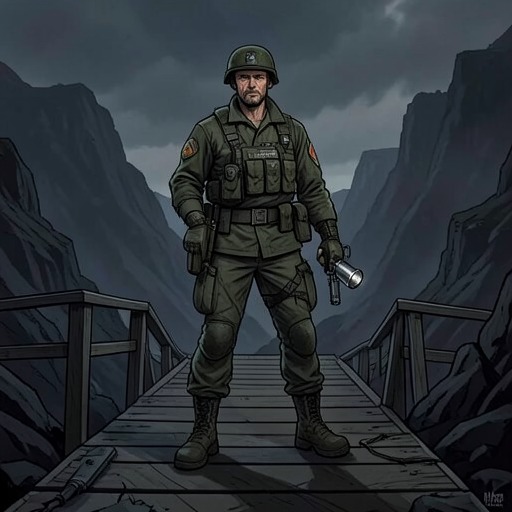
For Whom the Bell TollsRobert Jordan is an American demolition expert sent behind enemy lines to destroy a bridge, a task whose technical simplicity conceals its human danger. He can calculate charges and firing positions with precision, but the mission forces him to weigh military necessity against the lives of Anselmo, Maria, and the guerrillas whose trust he needs. His defining conflict is not whether he knows how to demolish a bridge, but whether a plan can remain responsible when its chances of success collapse.
Identity and Introduction
Robert Jordan enters the story hungry and worried, though neither discomfort nor personal danger ordinarily unsettles him. Experience has taught him that moving behind enemy lines is manageable with a good guide; the harder problem is deciding whom to trust. He believes trust must be complete or absent, and initially distinguishes his confidence in Anselmo’s skill from his uncertainty about the older man’s judgment. Assessing judgment, he recognizes, remains his own responsibility.
Anselmo has guided him through the mountains since before daylight, and Jordan admires the older man’s endurance and ability to find a way across difficult ground. The bridge assignment itself does not seem technically daunting. Jordan knows how to demolish bridges of many sizes and constructions, and the two packs contain enough explosives and equipment even if this bridge is twice as large as Anselmo’s report suggests. He has also seen it before, during a walking trip to La Granja in 1933, and studied its description with Golz on a map outside the Escorial.
Jordan’s introduction to the guerrillas establishes the outsider status from which he must work. When he greets Pablo, the heavily built, scarred band leader answers grudgingly. Others call Jordan Inglés, but he corrects Pilar: he is American. Later, asked directly whether he is the dynamiter, he confirms it; Joaquín has already heard of his arrival. Jordan’s identity is therefore both practical and relational: he is the specialist on whom the operation depends, but also a foreigner whose authority must be earned among people who will bear its risks.
The Bridge Plan and Its Human Cost
Jordan’s technical confidence coexists with a growing awareness that the operation cannot be reduced to engineering. Walking beside Maria, he sees the bridge in his mind with almost photographic clarity: the two posts, the empty road and its approaching movement, the positions of the automatic rifles, and the sequence for placing, wiring, and detonating the charges. The precision of the imagined procedure gives way to questions about what may go wrong. He recognizes that the people he likes must be used as troops, exposed to risks he would have to accept even if he felt nothing for them. Pablo grasps the operation’s danger at once; Pilar supports it, though its full implications weigh on her; El Sordo is willing to act without welcoming the cost. Jordan’s command depends on these people, but that dependence makes the plan morally immediate.
The conflict sharpens when Jordan sits in the cave with his notebook and works out the demolition. He draws three technical sketches and makes two drawings of the method, deliberately explaining it clearly enough that Anselmo could finish the task if Jordan were incapacitated during the demolition. He then writes two pages of operation orders and rereads them. The work is an act of professional preparation, but also a recognition that the mission may outlast its planner. At the table, Maria sits beside him and watches; when she places her hand near his, he lifts it to his face, then returns to the drawings without looking at her. Private tenderness and operational discipline occupy the same cramped space, neither canceling the other.
Jordan’s attention to military intelligence is equally concrete. While Anselmo watches the snowy road, he counts vehicles on two sheets torn from Jordan’s notebook: ten have gone up and six down, with four more still expected upward. Anselmo records each simply as a motorcar. Jordan, absent from the observation post, would have distinguished ordinary divisional vehicles from the more prestigious cars of the General Staff and understood the significance of the traffic. The episode exposes a limit of delegated observation: Anselmo follows orders and gathers numbers, but interpretation remains Jordan’s responsibility. Even in the snow, cold enough that Anselmo considers returning to camp, he stays because Jordan told him to wait and worries that Jordan might otherwise lose his way. Their cooperation is built not only on expertise but on obedience and trust.
When Jordan later reassesses the forces available, the confidence of the earlier plans turns into a stark calculation. The available men can take either of two posts securely, he concludes, but cannot be counted on to take both. Trying for both could kill Pilar, Anselmo, Agustín, Primitivo, Eladio, Rafael, Fernando, and Maria without ensuring the bridge is blown. The failure of El Sordo’s position has made the danger plain, while the dispatch that might reach Golz and stop the offensive remains uncertain. Jordan recognizes that he had made a plan he now considers impossible because he could not accept how badly the situation had changed. His anger at Pablo’s earlier withdrawal gives way to a more painful admission: the danger was already there, and the responsibility for committing the group cannot be shifted onto someone else.
Command, Trust, and Responsibility
Jordan tries to hold the operation together through explicit trust and disciplined obedience. He asks the guerrillas to trust him and follow orders even when those orders seem wrong, explaining that the military objective is to win the war and that combat demands confidence because events may not be what they appear. He links this appeal to the group’s recent experience: the cavalry encounter and the decision to send away the horses have demonstrated that an order can make sense only in light of circumstances not everyone sees. His authority is thus not presented as effortless command; it must be sustained by an agreement to act together amid incomplete information.
That agreement is tested by the need to get a warning to Golz. Jordan decides to write a dispatch for Andrés, specifying where the general can be found at the divisional headquarters. Anselmo worries that Andrés will not understand the distinctions among military divisions and argues for naming the general and giving a direct location. Jordan insists that the headquarters is where Golz will be found. The exchange makes the urgency of communication tangible: a written message may alter the offensive, but it must pass through a chain of people who do not share the same knowledge of military organization.
Pablo’s return complicates Jordan’s judgment of him. After disappearing, Pablo comes back and tells Jordan that, at bottom, he is not a coward. Jordan is glad to see him despite his continuing distrust. Pablo says he has ridden since leaving and brought five men from Elias and Alejandro; the force is still inadequate for the planned assault on both posts, where one post alone has seven men and a corporal. His return changes the practical situation, but it does not erase Jordan’s recognition that the original plan demands more than the available group can reliably accomplish. The alliance is necessary, compromised, and renewed through action rather than reassurance.
Jordan takes direct responsibility for the weapons as well as the plan. When Pablo warns him about handling the automatic weapon at the bridge and raises the danger of Agustín accidentally shooting him, Jordan says he will operate it himself. He claims extensive experience and promises to ensure that Agustín keeps the other weapons aimed well above Pablo. The reply is both technical assurance and an effort to contain the mistrust within the group: the men must cooperate at close quarters, where a misplaced burst could make their own comrades as vulnerable as the enemy.
Violence, Love, and the Limits of the Mission
Jordan’s professional competence requires him to kill, but the acts are not rendered as abstractions. In the snowy woods, when a mounted enemy soldier sees him and reaches for the short automatic rifle at his saddle, Jordan aims at the man’s chest and fires. The horse bolts, dragging the wounded rider by his caught foot through the trees. Jordan’s action is immediate and tactically necessary; its brutal consequence remains visible in the body dragged behind the horse.
His relationship with Maria gives the operation a different stake. He reaches across the trail and touches her arm, testing whether their closeness is real rather than a dream; her smile confirms the encounter. Later, he tells Agustín that he intends to marry her because he cares for her greatly. The intention matters even though the revolution makes formal marriage unnecessary and Agustín treats it as something to do later. Jordan’s attachment is not separate from his command: when he measures the danger of the plan, Maria is among those he fears it may kill.
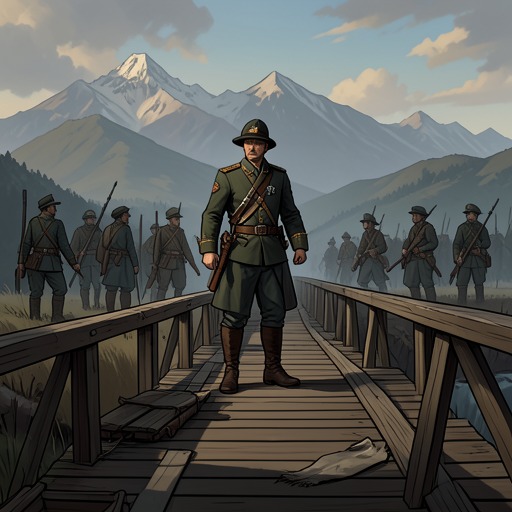
At the bridge, the distance between military procedure and human consequence becomes stark. Jordan steadies his elbows, aligns the submachine gun’s sights on a sentry’s chest, and fires as the man stands in the sunlight looking toward the bombing. The sentry falls forward, his rifle beside him, and Jordan turns his attention toward the other post as Anselmo’s shots and the explosions begin. Carrying the two heavy packs down the slope, he joins the action he has planned and the people he has placed in danger. The bridge is blown, but the success does not make the operation clean or restore the lives exposed to it.
The final pursuit leaves Jordan gravely constrained. After the band’s horses pass, Lieutenant Berrendo rides along their trail, forced to circle around because the bridge has been destroyed. Jordan lies behind a pine tree, holding himself carefully to keep his hands steady and waiting for the officer to reach a sunlit opening. The narrative ends with him poised to act despite his precarious condition; it does not show the result of the encounter. His mission has achieved its central military objective, yet the ending withholds any easy triumph, leaving Jordan’s body, judgment, and fate suspended in the immediate demands of combat.